
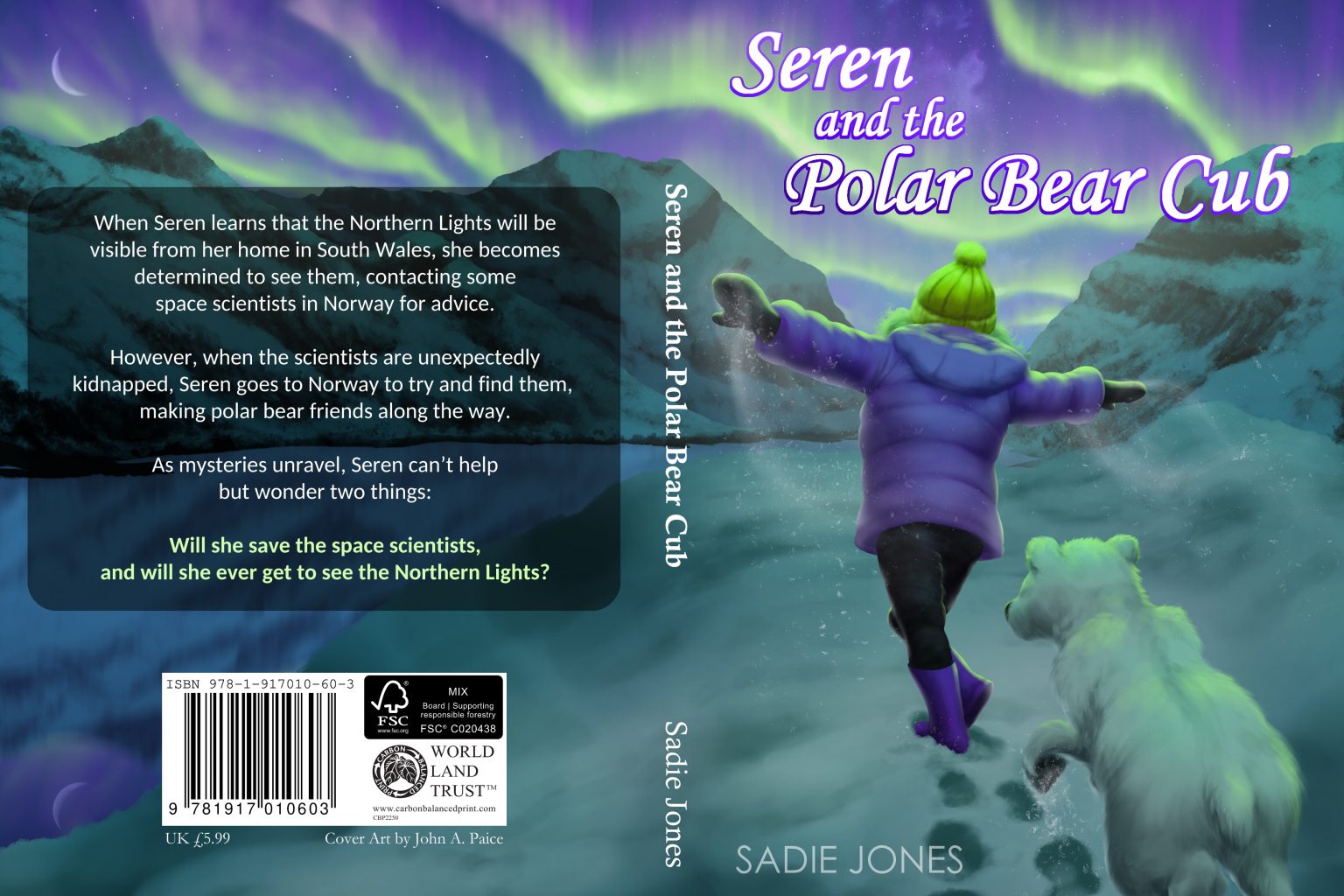
This new, children’s fiction book is all about a young girl who is inspired by the prospect of seeing the aurora from her own garden in South Wales. She ends up in Svalbard on an epic adventure with some space scientists from the University of Southampton. The subject of the book is very ‘on trend’ among British children because recent solar events meant the aurora was visible in the UK in May and October of last year.
From the Sadie:
I have self-published the book with funds from the University of Southampton where I work as the ‘Astronomy Public Engagement Leader’. I applied to fund the self-publishing of this work through our ‘Public Engagement with Research unit’ and they agreed to fund the cover illustration and printing of the first 750 copies so the book can be used as a vehicle to engage young children with the University’s Aurora science research.
I launched the book at our ‘Hands on Humanities family day’ in November 2024, this a free event which runs in Southampton city centre to engage the public with the Humanities. After the popularity of the book at this event I then secured further funding from both the Astronomy and Space Environment Physics research groups for a second print run to allow me to give out another 250 copies at our Science and Engineering Family Day in March 2025.
To date I have distributed over 1,400 books – most of these were given out for free to children at outreach events at primary schools as part of our ‘Aurora Art’ workshop or posted to schools for their school library (with >45 of those books being purchased for £5.99 each by people across the world).
The inspiration for this book came from my own adventure in January 2020 where I accompanied my space scientist colleagues on an expedition to Svalbard, Norway (see images of me outside the Radar station above). My part in the expedition involved writing a daily blog and linking up with local schools in order to launch tour new ‘Aurora Zoo’ citizen science project (aurorazoo.org). After seeing the aurora for the first time on that trip and having a real-life encounter with a polar bear, I felt compelled to write a children’s story set in this amazing and weird place.
Neurodivergence
Having also recently been diagnosed with ADHD, I have been looking back on my own experiences in school. I remember feeling very isolated sometimes, because I knew I was different, but I didn’t know why. Now I know, and my struggles in school, specifically in social situations, make more sense. So, after this revelation; It was important to me that my book’s heroine also had ADHD. I know as young child I would have appreciated reading a book about a child who was ‘just like me’. I try to use comedic writing as much as possible to showcase how Seren’s neurodiversity can also be a strength.






Leave A Comment